Responsible Feature Engineering: Advancing Fairness from Post-Hoc Audit to a Design Discipline
U.S. Census Bureau Emerging Technology (xD) Fellowship
With Atul Rawal
Problem
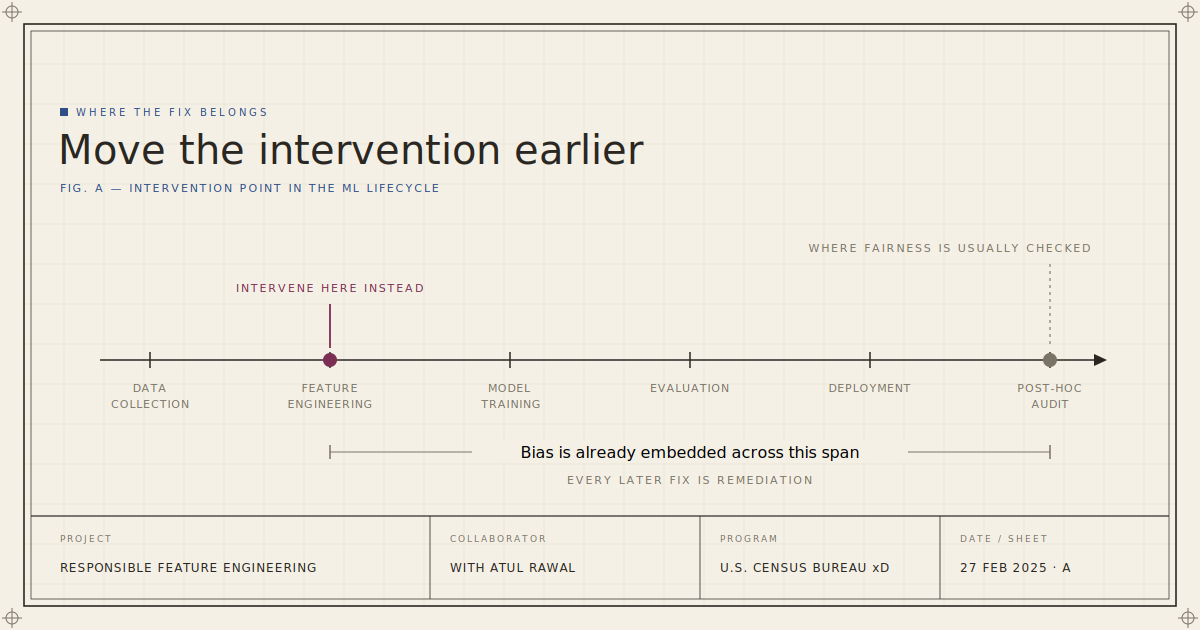
Most AI fairness interventions occur after model development, typically through output audits that address harms only after they’ve affected people. This overlooks an earlier and more effective intervention point. By the time a model generates predictions, the decisions about data inclusion and feature selection have already been finalized—bias introduced during feature engineering is embedded before any assessment of disparate impact or model evaluation begins.
The more effective intervention happens earlier: feature engineering is the stage where data scientists can assess whether a feature behaves differently across the populations a model affects. Remediation at this stage is significantly more cost-effective than post-deployment fixes.
My focus sits at the intersection of the organizational system—the machine learning lifecycle and an organization’s governance practices—and the cultural system, where bias gets encoded as a seemingly neutral technical property with real consequences. The gap is that practitioners lack a standardized method to evaluate feature fairness at the point of selection.
Solution
In addition to post-hoc audits, I shifted the intervention to the earliest stages of the data lifecycle, before model development. Together with Atul Rawal, I developed a framework and paper introducing Responsible Feature Engineering (RFE) as a formalized practice within the machine learning lifecycle.
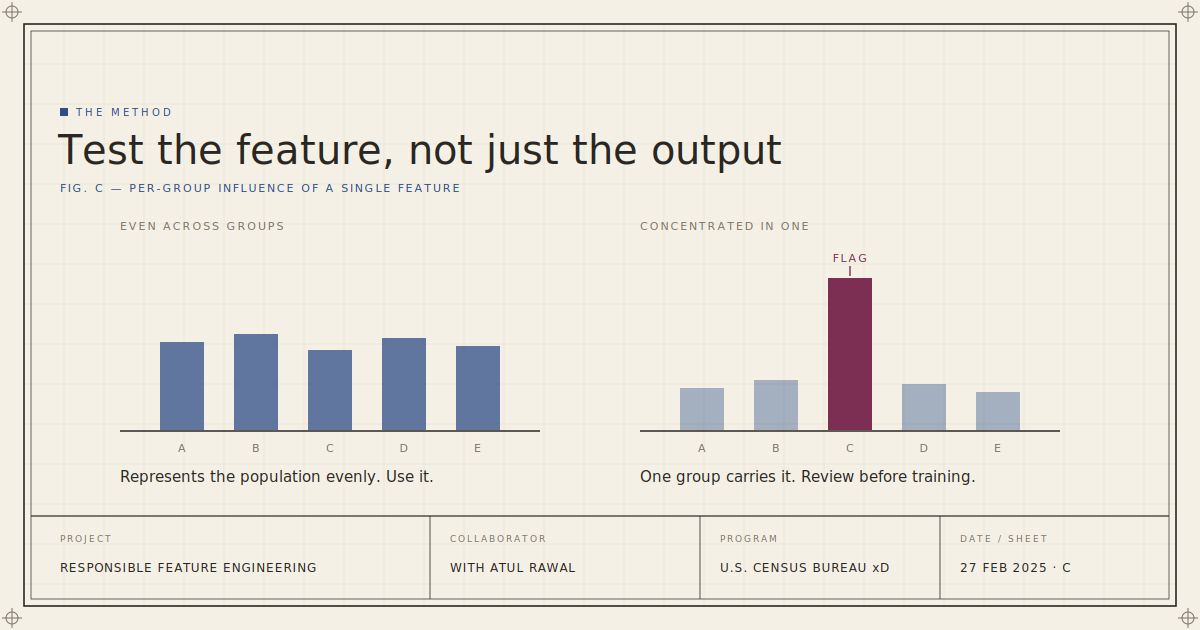
The central method evaluates how a feature’s influence varies across the demographic groups a model affects. Consistent behavior across groups indicates fair representation; disproportionate influence for a specific subgroup signals the need for further investigation before using the feature in training.
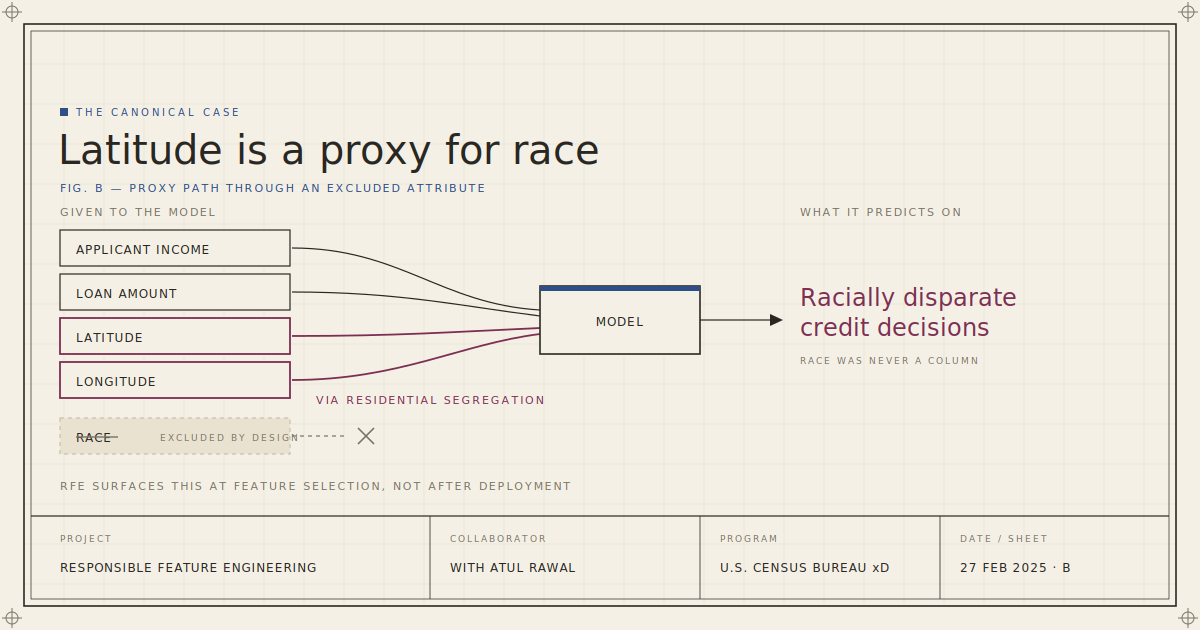
The canonical example: latitude and longitude may appear neutral, but because of racially segregated residential patterns in the United States, these variables act as proxies for race. Models trained on location data in housing or credit contexts can produce racially biased predictions without ever explicitly encoding race. RFE exposes issues like this before they cause harm.
The framework is intentionally model-agnostic, built to be adopted as a standard practice rather than a niche technique. RFE also provides guidelines for when disparities should prompt review by domain experts or community governance, rather than relying solely on automated adjustments—keeping a human in the loop.
Impact
Practitioners in regulated sectors—housing, credit, healthcare, employment—get a concrete intervention point before fairness issues are amplified during model training and deployment. That matters most in civic contexts, where models affect populations with limited avenues for recourse or transparency into how decisions were made.
This methodology argues for both a cultural and a technical shift: repositioning fairness practice from a post-hoc compliance measure to a foundational part of data design, shaping model development from the outset. Bringing impact considerations in early means measurement and testing get built in proactively, rather than bolted on.
A reviewer, Severen, raised a critical question: had we quantified the risk of underfitting when removing features for fairness? That question names the real tension—excluding a biased but predictive feature has a cost. RFE doesn’t resolve that dilemma, but it puts the issue in front of practitioners and makes an implicit decision explicit. Right now, that decision is often made by default and stays invisible to the people building and reviewing the model. RFE is a tool for surfacing the decision, not automating it—the judgment stays with humans, ideally including the communities the model affects.
For RFE to become standard practice, it needs pipeline tooling at the feature selection stage, evaluation studies using real-world regulated-domain datasets, and partnerships with domain experts and communities who can identify latent variables that engineers may overlook on their own.
Stack & Methods
Feature influence testing across demographic groups · model-agnostic fairness framework · proxy variable analysis · U.S. Census Bureau Emerging Technology (xD) Fellowship · co-authored with Atul Rawal.